High security · Newbury
Safe Installation & Servicing in Newbury
A homeowner inherited a heavy old dial safe from a parent's house, moved it into the new place, and has no idea whether the bolt-work still works, whether the lock is sound, or how it should be anchored.
In plain words
Plenty of visits under this service involve a safe that has been sitting in a back office for years rather than a new one arriving in a box. The locksmith opens the bolt-work, cleans and lubricates the moving parts, tests the lock through several full cycles, and checks whether the anchoring underneath is still solid or was never done at all. Batteries in an electronic lock are swapped before they fail rather than after, and any stiffness in the handle or bolts is traced to rust, dried grease, or a worn part and corrected on the spot.
How the visit goesBehind the filing cabinets sits a heavy floor safe nobody ever bolted down, left exactly as the last owner set it. It opens fine, but a determined pair of hands could simply tip it into a van.
Safe Installation & Servicing
How the visit goes
The floor or wall it will sit against
The surface behind the safe decides how it gets anchored, so it is checked before anything is ordered. Solid concrete accepts one style of anchor bolt; a wood subfloor over joists needs a different fastener reaching into structural framing rather than just the surface layer; a tiled floor cannot take a bolt at all without risking a crack around it. The locksmith also looks for slope, dampness, or a cold exterior wall that could sweat in humid weather, since all three affect where the safe should actually stand, not just how it gets bolted down.
Setting it level and in its final position
Once the safe is on site, it is moved into position with a hand truck, dolly, or rigging suited to its weight, protecting door frames and flooring along the way rather than dragging it across a room. It is set level using shims where the floor is slightly uneven, since a safe that sits even a little off level can bind its own bolt-work over time. The final position also leaves enough clearance for the door to swing fully open and for anchor bolts to be reached from underneath or behind.
A combination or code that belongs only to the household or business
The final combination or code is set by the owner alone, after the locksmith has finished testing, so nobody who did the installation carries it away in their head. Writing it down somewhere other than beside the safe, or storing it with a trusted person away from the property, is worth doing once rather than relying on memory during a stressful moment. Where the lock supports more than one code, deciding now who else should have one avoids an awkward conversation later.
Safe Installation & Servicing
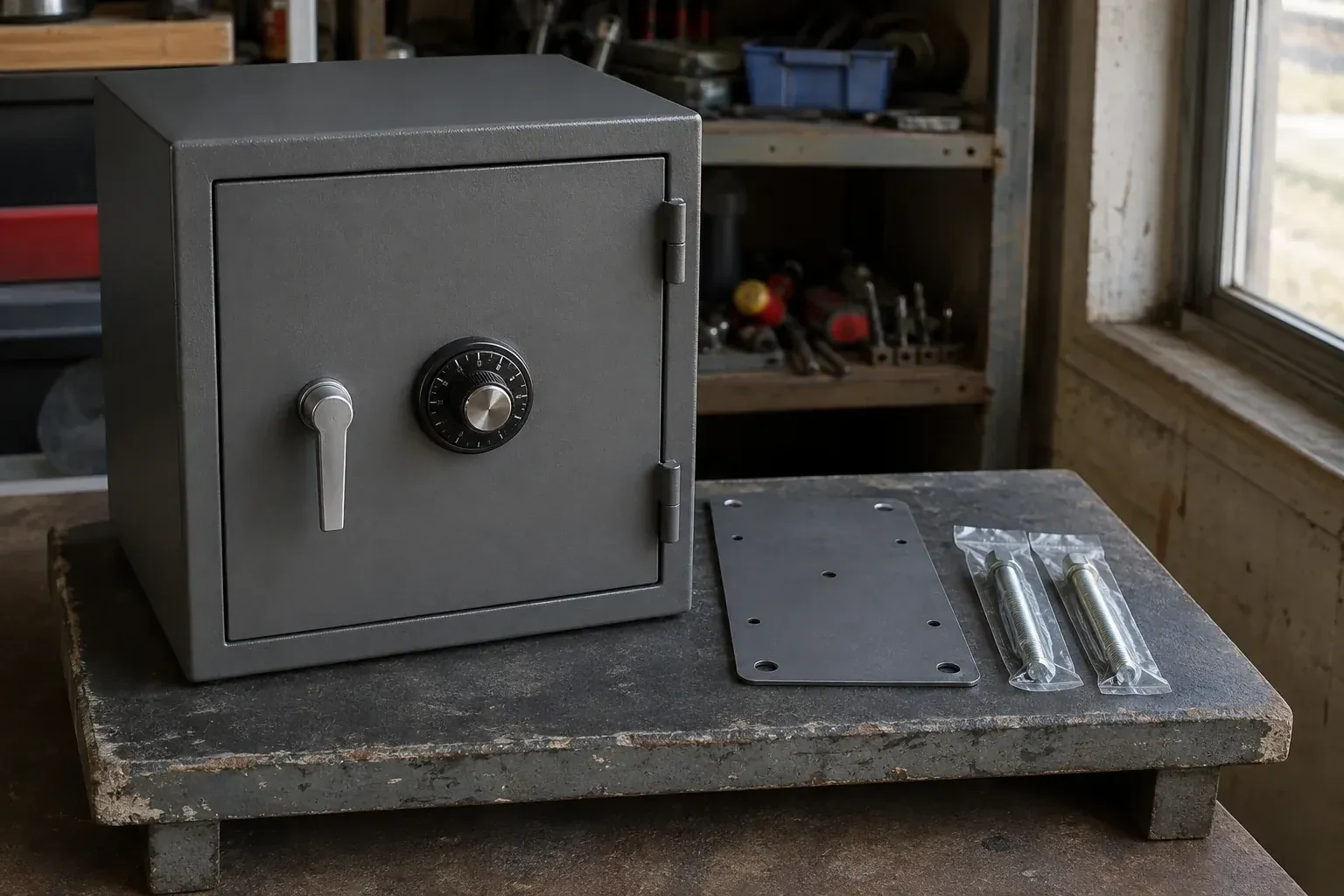
In the van
Desiccant packets
Torque wrench and socket set
Mounting plate
Level and floor shims
Concrete anchor bolts
Safe Installation & Servicing
What affects the quote
Lock type and number of users
A mechanical dial lock with one combination is a simpler setup than an electronic keypad supporting several separate user codes for different staff members or household members.
Size and weight of the safe
A larger, heavier unit needs more capable moving equipment and more time to position safely than a compact document safe, which shows up in the labour involved rather than the hardware itself.
Requests for concealment
Fitting a safe into a closet floor, a recessed wall cavity, or behind a built-in panel takes more planning than a straightforward open placement, and can limit which units will actually fit.
What to have ready
- Is that floor concrete, wood subfloor, or tile?
- Are there stairs or narrow doorways between the entrance and that spot?
- Does the lock use a dial, a keypad, or both?
Safe Installation & Servicing: questions
QuestionsWhy does the inside of my fireproof safe feel damp?
A fire-rated interior works by sealing tightly, and that same seal traps ordinary household humidity over time with nowhere to go. Opening the door for a few hours every few weeks lets trapped air exchange with the room, and a desiccant packet inside absorbs moisture between those openings if it is refreshed on schedule. A musty smell or a soft-feeling document is the interior telling you it needs airing out.
Can more than one person have their own code?
Yes, on an electronic keypad that supports multiple users, each person can be given a separate code rather than everyone sharing one, which also makes it simple to remove a single code later without resetting the whole lock. A mechanical dial lock, by contrast, has one combination for everyone who needs it, so a change in who has access there means changing that one combination.
What kind of floor can a safe be anchored to?
Solid concrete is the most straightforward surface, taking a masonry anchor bolt directly. A wood subfloor works too, provided the anchoring reaches into the floor joists beneath the surface layer rather than just the plywood or the flooring on top. Tile is the awkward case, since a bolt through it tends to crack the surrounding tiles, and an alternative anchoring point or a different spot in the room is usually the better route there.