High security · Strathroy-Caradoc
Safe Installation & Servicing
A homeowner inherited a heavy old dial safe from a parent's house, moved it into the new place, and has no idea whether the bolt-work still works, whether the lock is sound, or how it should be anchored.
In plain words
A safe carries two separate report cards, and neither one predicts the other. Some burglary ratings describe how long a determined attempt with tools takes to force the door, timed by an independent lab; others are construction classifications based on steel thickness rather than a timed attack. A fire rating describes how hot the interior gets in a timed furnace test, and it matters for paper and for cash, though burglary resistance is usually the bigger concern where cash is involved. Choosing between them, or finding a unit built to both standards, is the first real decision in an installation, and it depends on what will sit inside the safe.
How the visit goesThe accountant's office keeps a decade of client files in cardboard boxes because the only safe in the building is a small drawer safe meant for a laptop, nowhere near large enough for binders of paper.
Safe Installation & Servicing
How the visit goes
Whether the fire lining can breathe
A fire-rated interior works by trapping moisture inside its insulation, and that same airtight seal can hold humidity against paper and metal for years at a time. On a servicing visit the locksmith checks for a musty smell, damp interior panels, or documents that feel soft at the edges, all signs that trapped humidity has been building unnoticed. On a new installation, this becomes a conversation about desiccant and how often the door should be opened to let the interior air out, rather than something dealt with only after a problem appears.
Matching the safe to the two ratings
The visit begins by separating two decisions that people often blur together. Some burglary ratings come from an independent lab timing how long a trained attempt with real tools takes to force the door, expressed in minutes of net working time; others are construction classifications based on steel thickness and body design rather than a timed attack. A fire rating comes from a timed furnace test that measures how hot the interior gets, expressed as a temperature ceiling held for a set number of hours. A unit is chosen, or confirmed if it is already owned, against both numbers separately rather than a single vague idea of how secure a safe looks.
Paperwork worth keeping somewhere other than inside the safe
The model number, the burglary and fire ratings, and a note of how and where the unit was anchored are all details worth keeping on file, ideally somewhere other than locked inside the safe itself. An insurer asking about coverage for cash or valuables will often want exactly this information, and having it ready saves a search through old boxes later. A few photographs taken during installation, showing the anchoring and the rating label, cover most of what gets asked for afterward.
Safe Installation & Servicing
In the van
Desiccant packets
Torque wrench and socket set
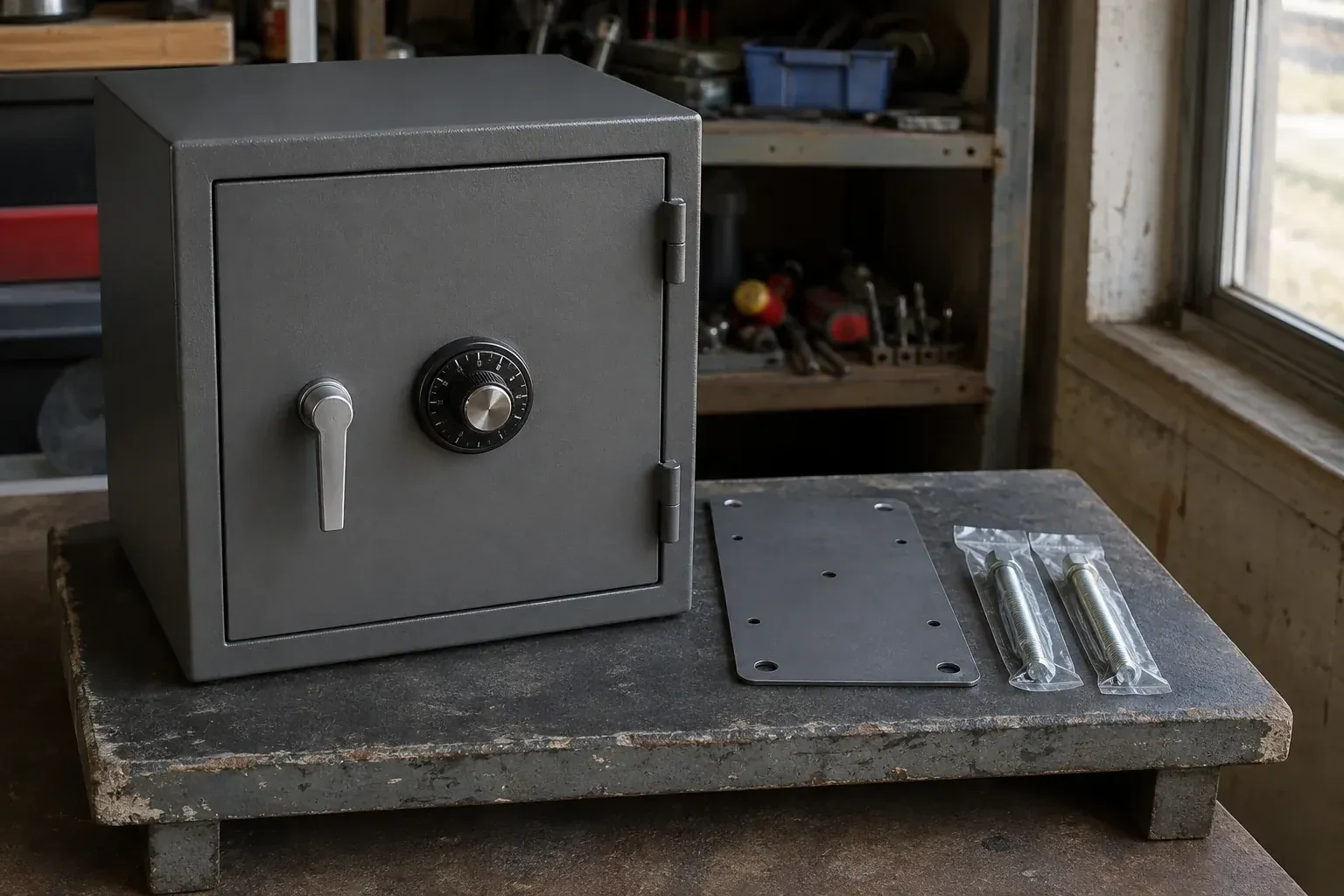
Mounting plate
Level and floor shims
Concrete anchor bolts
Safe Installation & Servicing
What affects the quote
Fire rating and duration chosen
A longer fire-rated duration or a lower protected temperature for digital media generally means thicker insulation and a larger overall footprint for the same interior storage space.
Floor or wall construction
Solid concrete, a wood subfloor reaching into joists, and tile each call for a different anchoring approach and different hardware, and the substrate is confirmed before any drilling begins.
Building access restrictions
A property requiring a booked loading dock, a service elevator reservation, or coordination with building management before a heavy delivery can arrive adds scheduling steps beyond the installation work itself.
What to have ready
- Is that floor concrete, wood subfloor, or tile?
- What floor or wall will the safe sit against?
- Is this a new safe or an existing one needing service?
Safe Installation & Servicing: questions
QuestionsWhy does the inside of my fireproof safe feel damp?
A fire-rated interior works by sealing tightly, and that same seal traps ordinary household humidity over time with nowhere to go. Opening the door for a few hours every few weeks lets trapped air exchange with the room, and a desiccant packet inside absorbs moisture between those openings if it is refreshed on schedule. A musty smell or a soft-feeling document is the interior telling you it needs airing out.
Can more than one person have their own code?
Yes, on an electronic keypad that supports multiple users, each person can be given a separate code rather than everyone sharing one, which also makes it simple to remove a single code later without resetting the whole lock. A mechanical dial lock, by contrast, has one combination for everyone who needs it, so a change in who has access there means changing that one combination.
What kind of floor can a safe be anchored to?
Solid concrete is the most straightforward surface, taking a masonry anchor bolt directly. A wood subfloor works too, provided the anchoring reaches into the floor joists beneath the surface layer rather than just the plywood or the flooring on top. Tile is the awkward case, since a bolt through it tends to crack the surrounding tiles, and an alternative anchoring point or a different spot in the room is usually the better route there.